Colosseum in Rome
Named after the gigantic statue of Nero that once stood nearby.


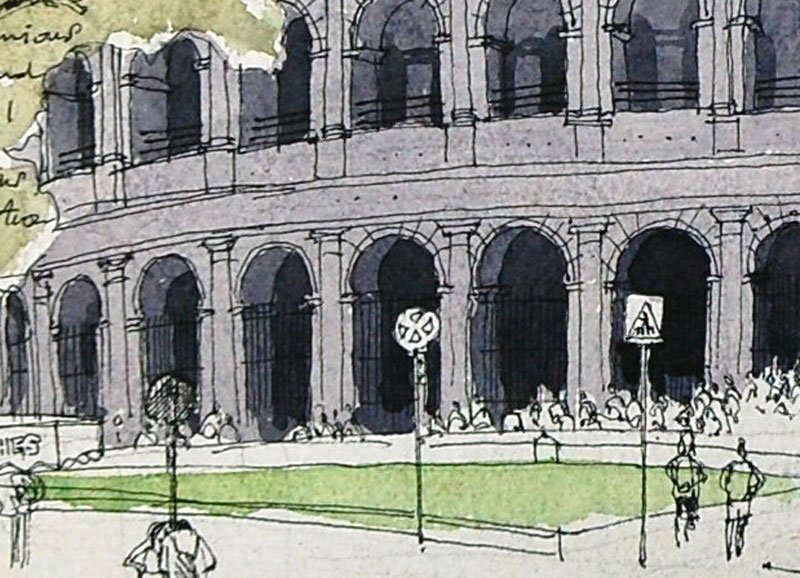

Colosseum in Rome
The Colosseum is an oval amphitheatre in the centre of Rome, Italy, and is the largest ancient amphitheatre ever built. It was constructed between 69 and 80 AD, with further modifications made under Domitian over the following decade. The three emperors that were patrons of the work are known as the Flavian dynasty, so the amphitheatre was named the "Flavian Amphitheatre" by later classicists and archaeologists for its association with their family name (Flavius).
I drew it in June 2000, while staying at the British School in Rome. I was tracing the footsteps of Sigeric, a Bishop who travelled to Rome in 994 to be made Archbishop by the Pope. He left a list of his stopping places along the way from Canterbury, and then a list of the churches he visited in Rome. He didn't mention the Colosseum but could not have failed to see it - together with the Pantheon it is one of the most remarkable and powerful physical memories of the might of Rome.
The Colosseum is built of travertine limestone, tuff (volcanic rock), and brick-faced concrete, and could hold an estimated 50,000 to 80,000 spectators. It was used for gladiatorial contests and public spectacles such as mock sea battles, animal hunts, executions, re-enactments of famous battles, and dramas based on Roman mythology. The building stopped being used for entertainment in the early medieval era and went through a series of re-uses, including being quarried for its stone by the local Roman families.
Although substantially reduced, the Colosseum is still an iconic symbol of Imperial Rome; it is one of Rome's most popular tourist attractions and also has links to the Roman Catholic Church, as each Good Friday the Pope leads a torchlit "Way of the Cross" procession that starts in the area around the Colosseum.
Rome, Italy
Available Prints
A3 Landscape - £59
A4 Landscape - £29
Prints are made with archival inks on one of two papers - either 350g Hahnemuhle German Etching paper, or 290g. Hahnemuhle Hemp, a beautifully heavy paper with rich colours. Made with 60% hemp fiber, this is an eco-friendly paper. Hemp is a highly sustainable resource, historically used for papermaking. Hahnemuhle use spring water for milling, and the production of hemp paper does not require bleaching or chloride, making the process less impactful. Postage and packing will be calculated on checkout.
Guide to Print sizes
| ISO | Size in Inches | Size in cms |
|---|---|---|
| A4 | 11.69 × 8.27 | 29.7 × 21 |
| A3 | 16.54 × 11.69 | 42 × 29.7 |
| A2 | 23.39 × 16.54 | 59.4 × 42 |
| na | 10 × 10 | 25.4 × 25.4 |
| na | 7.87 × 7.87 | 20 × 20 |
Framing and mounts
An A4 print is best framed in an A3 frame - these images work best with a decent amount of white space surrounding them.

